-
Oil imports
FAQs on sanctions against Russia and Belarus, with focus on the following provisions: Articles 3m and 3n of Council Regulation (EU) No 833/2014.
Frequently asked questions on oil imports concerning sanctions adopted following Russia’s military aggression against Ukraine.
Kindly find the link below.
-
FATF Releases Major Update on Terrorist Financing Risks
A new FATF report reveals serious and evolving terrorist financing (TF) threats, warning that many countries are still struggling to detect and prosecute these crimes effectively. Despite global efforts, nearly 70% of jurisdictions assessed show significant shortcomings in addressing TF risks.
The Comprehensive Update on Terrorist Financing Risks, co-led by France and the UN Counter-Terrorism Committee Executive Directorate (CTED), highlights how terrorist groups continue to exploit both traditional and modern financial systems—from cash couriers and hawala networks to social media, gaming platforms, and virtual assets.
Key insights from the report include:
- Increased use of mixed, digital methods to fund terrorism, blending conventional tools with emerging technologies.
- Greater decentralisation of terrorist financing, with local cells and regional hubs adapting tactics to their contexts.
- The rise of lone actors, often younger individuals, using microfinancing and tech-based tools to raise and move funds.
- Convergence of terrorism financing with organised crime, adding complexity to tracking and disruption.
- Risks to humanitarian aid, especially in conflict zones, where there’s potential for aid to be misused for terrorist purposes.
The report draws on data from over 80 countries, 10+ years of case studies, and more than 840 stakeholder submissions. It emphasizes the urgent need for stronger global coordination, risk-based measures, and enhanced public-private partnerships to detect and disrupt TF activity.
UN CTED Executive Director Natalia Gherman welcomed the report as a model of international collaboration, noting its role in helping states strengthen their response in line with UN Security Council mandates.
To read the full report, please click here.
-
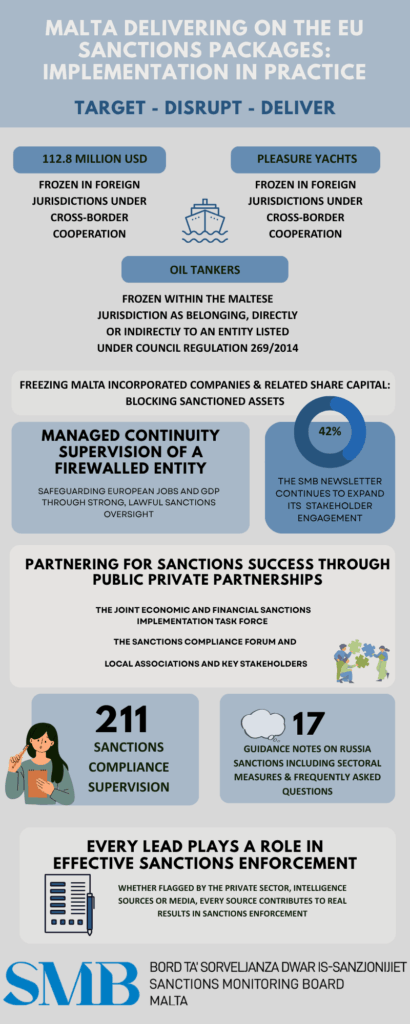
Malta Delivering on the EU Sanctions Packages: Implementation in Practice
TARGET – DISRUPT – DELIVER
Malta’s Implementation of EU Sanctions on Russia
The European Union has adopted seventeen consecutive sanctions packages to limit Russia’s ability to finance its war and to hold accountable those who support it. These sanctions present complex implementation challenges but they have also created an opportunity and a responsibility for EU jurisdictions to demonstrate resolve and coordination. Malta has responded with a clear commitment to implement these sanctions rigorously, effectively and in full alignment with EU law.Delivering Results
Malta actively identifies and targets designated individuals and entities, disrupts attempts to circumvent restrictions and delivers real, measurable results. Our actions extend beyond our borders: through cooperation with international counterparts, Malta has contributed to the freezing of over $112 million in assets held abroad. Domestically, we have taken action against luxury assets including yachts as well as two oil tankers and frozen the assets and shares of multiple Malta-registered companies following checks under Council Regulation (EU) No 269/2014.
In one significant case, Malta imposed strict controls described as a “firewall” on sanctioned individuals with ownership ties to a Malta-registered company with extensive operations through a multitude of companies and employment links across mainland Europe. These controls ensure that all transactions undergo prior scrutiny and require approval, allowing legitimate activity to continue under close supervision while preventing misuse of frozen assets.
Partnership with the Private Sector
Malta’s sanctions enforcement model is rooted in cooperation. Through initiatives like the Joint Economic and Financial Sanctions Implementation Task Force and the Sanctions Compliance Forum, we work hand-in-hand with operators to solve practical challenges, clarify obligations and support effective compliance. Continuous dialogue with stakeholders ensures that Malta’s national approach remains practical, proportionate and enforceable.
Supervision and Outreach
Monitoring compliance is central to our mission. Together with the Financial Intelligence Analysis Unit, the Malta Financial Services Authority and the Malta Gaming Authority, the Sanctions Monitoring Board supervises compliance by subject persons. This includes client screening, transaction monitoring and adherence to reporting duties. To date, we have conducted 211 inspections across multiple sectors.
We also prioritise outreach. Updated guidance is regularly published to support industry implementation, and our Sanctions Newsletter has seen a 42% increase in subscriptions since the Russia-related sanctions began.
Enforcement and Accountability
Effective enforcement is essential. All reports, whether from businesses, intelligence sources, whistleblowers, foreign partners, or the media, are thoroughly reviewed. Where necessary, cases are referred to law enforcement, and there are cases advancing through judicial channels.
Looking Ahead
Malta remains committed to working closely with EU partners and Ukraine, in the hope that the war ends as soon as possible. In the meantime, we will continue to do our part to ensure the EU’s sanctions architecture is robust, credible and effectively implemented.